Scheme design
Design the market before you launch it.
Will a peer-to-peer scheme work? How much local demand can local generation meet, what is that energy worth, and who should get what? Gridform answers those questions on real meter data, before anyone signs.
The questions that decide a scheme
Know what a scheme is worth, not just whether it can run.
How much stays local?
See the share of demand that members can supply to each other.
What is it worth?
See the value of energy traded by month, quarter or year, and per asset.
Who should be in it?
Move sites between groups, or open and close them to local trading.
How should capacity be shared?
Split the output of a solar farm, wind farm or battery in the shares you choose.
What price works for both sides?
Test flat community prices, evening premiums and time-of-day rates.
What happens if it grows?
Add members and assets to a version of the scheme, and roll it forward with forecasts.
The Workbench
Try every idea. Risk nothing.
Explore a scheme the way you would a financial model, without waiting on analysts or touching live data.
Start from what you have
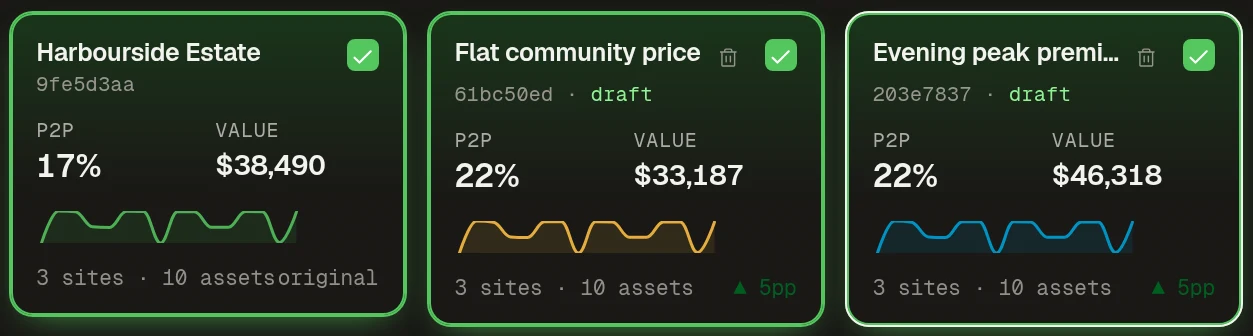
Pick an existing scheme as your baseline.
Copy and change it
Make as many versions as you like, with different structures, shares or prices.
Compare
Each version runs through the same matching as a real settlement, on your own readings.
Launch the winner
Promote your choice and it's published, ready to settle.
Provider margin
Price an offer that works for you and your customer.
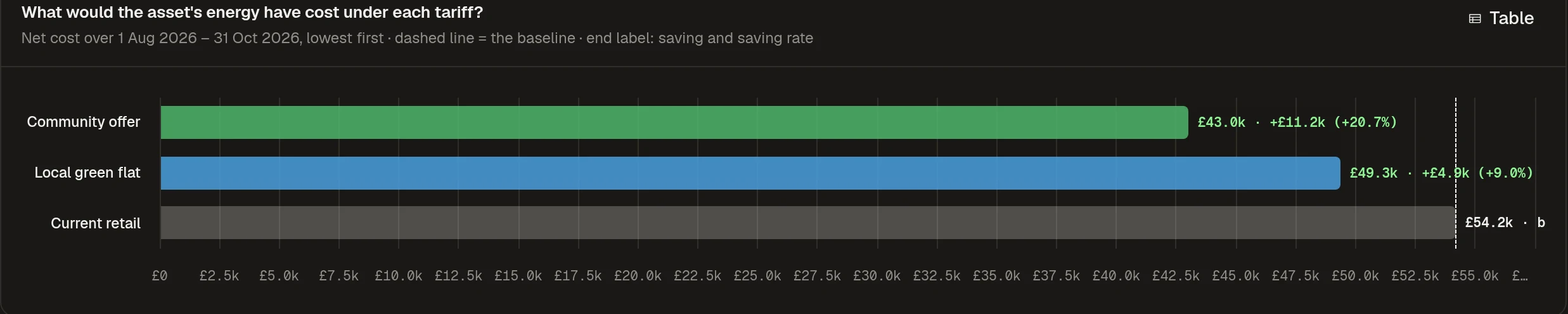
Price a customer's real usage under up to ten tariffs. See what each offer saves them, how much margin you can add while they still save your target amount, and whether it holds up if usage or spot prices change.